
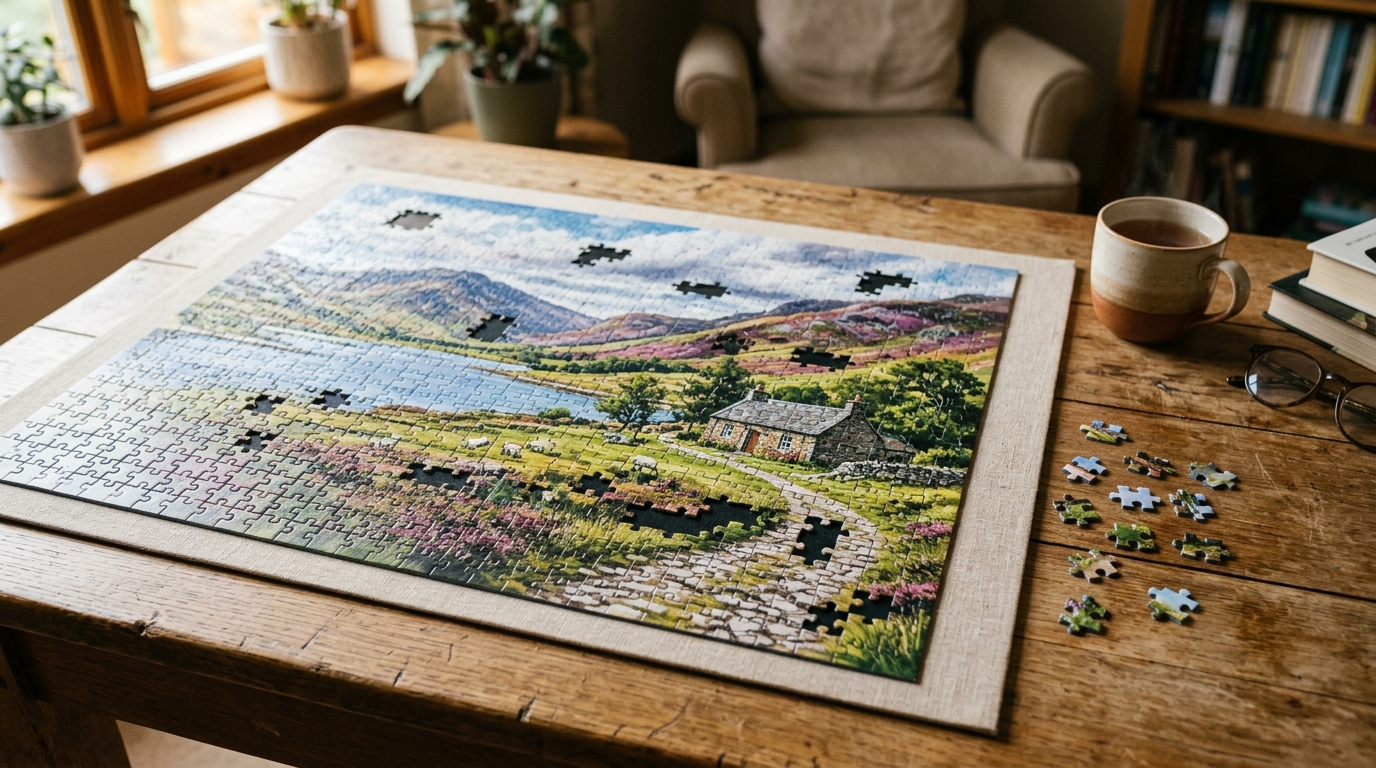
The box lid is the only piece of a jigsaw that is already complete. Looking at it for ten seconds can save a much longer search later. Jigsaw puzzle box art gives that moment a name, but the useful part is the habit behind it. The aim is not to make every move look clever. It is to make the next move easier to explain.
Why Jigsaw puzzle box art matters on an ordinary puzzle
Jigsaw puzzle box art gives the solver a map of color, depth, texture, and object position before any piece is moved. Historically, the picture helped make a dissected image teachable and repeatable. In a daily online puzzle, the reference image still determines which clues deserve attention first. A player does not need a special setup to use this idea. It works during a short browser session, on a printed page, or in the middle of a game when attention is starting to drift.
Jigsaw solving works the same way with visual evidence. Color suggests a region, texture narrows it, line direction gives it a path, and shape decides whether the connection is physically plausible. No single clue needs to carry the whole decision. The useful habit is to let one clue invite a test and let the other clues approve it. That keeps a difficult image from becoming a sequence of random clicks. It also gives you a natural place to pause when the evidence runs out.
The wider background is worth keeping nearby. Museum of Play jigsaw puzzle history offers useful context for this puzzle family, while Britannica jigsaw puzzle overview gives a second view of its rules or history. The sources differ in purpose, but both support the same practical lesson: a clear structure gives the player something reliable to inspect.
How to use Jigsaw puzzle box art without forcing it
Read the image in layers. Find the strongest object, the sharpest line, and the broadest low-information area. Start with the object or line, not the plain sky or water. When the first island grows, use its location on the reference image to reject visually similar pieces from distant regions. Start with a legal move and let the evidence narrow the field. If the position does not improve, stop. A good technique is a filter, not a command to keep pushing the same idea after the board has moved on.
A short routine for the next game
Before each session, name one landmark and one area to ignore for now. Build around the landmark, then return to the reference whenever two candidate pieces look equally plausible.
- Find the sharpest landmark in the reference.
- Separate high-information and low-information areas.
- Build around one object or line.
- Use the reference to reject distant lookalikes.
The mistake that makes this idea feel harder
The trap is sorting by the most noticeable color rather than the most informative feature. Another mistake is keeping the box image visible but never consulting it after the first minute. The reference is a working tool, not a decoration beside the pile.
What to remember when the board changes
Jigsaw puzzle box art makes a difficult image less flat. It tells you where the picture changes, and those changes become the first boundaries your hands can build. That is also why Jigsaw puzzle box art should stay practical. Use it when it describes the board in front of you, then return to ordinary reading when the evidence changes. A puzzle is allowed to ask a different question on the next move.
If Jigsaw puzzle box art does not produce a move today, that is useful information too. Leave the position clean, keep the strongest clue visible, and come back after one ordinary move. Techniques become reliable through that small return: notice the signal, test it, record what changed, and stop before the idea turns into a guess. Over time, the pause becomes part of your solving rhythm rather than a sign that the puzzle has defeated you.
Keep the session concrete. Name the clue, make one reversible change, and look again. That is enough for a useful practice round, even when the puzzle is unfinished. A short note about what changed makes the next session easier to start.
For a live session, play more puzzles on daily-jigsaw-puzzle.org. When you want a related example, browse related posts on this site. You can also try another daily puzzle at Easy Daily Puzzle or find more puzzle guides on Easy Daily Puzzle. Keep the next step simple: play one puzzle, try the routine once, and notice which decision became clearer.
A jigsaw session can stop with one island unfinished. Keep the strongest visual group together and return to the reference image next time. The goal is to preserve a useful question, not to force a final piece.